

The Southern Most Field Report
The Flow Trip60 years after her great-grandparents arrived on one of the first civilian flights to the South Pole, environmental science journalist and photographer Avery Schuyler Nunn chronicles her visit with penguinologists on the Antarctic Peninsula.
Words, photos, and scribbles by environmental science journalist and photographer Avery Schuyler Nunn

It’s strange to visit a place knowing that you may never get to set your eyes on it again in your lifetime. I suppose that could be said of every moment in life, but when in the remotest region on our big blue marble, it’s a sensation that is heightened. The phrase “feast your eyes” is often used sarcastically or alongside a witticism, but it’s a collocation that I practice in earnest when working out in the field (which, as it happens, has never actually involved a “field”). No matter how much you allow your eyes to focus, unfocus, and refocus, no matter how much you visually feast on what’s around you, in Antarctica, you feel as though you could never open your eyes or ears quite wide enough to take it all in.

One of the first things that someone born in 1997 will recognize when arriving at the bottom of the world is that the Gatorade flavor “Glacier Freeze” is quite aptly named. While sections of the seas are ink-dark, the shallows and waters beneath icebergs are a striking turquoise blue.


Along the Antarctic Peninsula — where my life partner and I accompanied a few penguinologists — a cacophony of braying calls and guttural squawks poured out from icebergs sprinkled with penguins and the coastal coves where they nest. Thunderous rumbles of glacial movement seemed to bounce off of the mountaintops and roll down the couloirs. The icebergs are enormous and fantastical. Their shapes so diverse, exaggerated and sculptural, that I can only think to describe them as Seussian. It is as if some playful, untethered imagination dreamed up this place first — and only later did the wonders of Earthly reality agree to make it so. The soft, percussive poofs of humpback, minke, and orca whale blows constantly emerged in the distance.

Even amid the rapid shifts reshaping this place, I was struck by how astonishingly wild, whole, and healthy it feels. A wilderness in the truest sense of the word.
As we skimmed across a glassy channel toward a Gentoo penguin colony, researcher Tom Hart gestured toward the open water. Just five decades ago, he said, this very stretch would have been locked in ice. I tried to picture the dark waters sealed over, wind-scoured and white, and wondered what those who had come before would make of the view now.

Crazily enough, two of those who had come before were my own kin.
When my great-grandparents, Elmer Arthur and Lillian Barbara Nunn, landed on the seventh continent 58 years ago, Antarctica was indeed a very different place.
The western flank of the peninsula would have been locked in seasonal sea ice for far longer each year. Since Grandpa and Grammy visited, parts of this peninsula have warmed by nearly 5 degrees Fahrenheit — one of the fastest regional temperature increases on Earth. Ice shelves that once fringed its eastern coast, including the Larsen A Ice Shelf and Larsen B Ice Shelf, were still intact at their time. Larsen B spanned roughly 1,250 square miles before it catastrophically disintegrated in 2002, when a Rhode Island–sized slab of floating ice fractured into shards in a matter of weeks. Those shelves had acted as architectural buttresses, holding back inland glaciers. Without them, tributary glaciers accelerated, some doubling or tripling their flow speed, pouring additional ice into the sea. The peninsula is now a very tangible contributor to global sea-level rise.


The ocean itself has changed, too. Warmer circumpolar deep water now intrudes onto the continental shelf more frequently, melting ice shelves from below. The surrounding Southern Ocean has absorbed vast amounts of anthropogenic carbon dioxide, making its surface waters measurably more acidic than they were in the 1960s. That shift alters the chemistry available to organisms that build shells — including pteropods, a foundational prey species in Antarctic food webs.


And yet, not all trajectories of this ecosystem bend downward.
In 1968, industrial whaling had reduced Antarctic humpbacks by roughly 90 percent and blue whales to perhaps 1 to 2 percent of their pre-1900 numbers. The waters my great-grandparents observed that year would have held far fewer blows on the horizon. Today, humpbacks have rebounded dramatically along the peninsula — with some populations nearing historical estimates.


At the center of Antarctica’s ecosystem is krill — thumbnail-sized crustaceans that are the basis for the entire food web. Their larvae depend on winter sea ice, feeding on algae that grow beneath its frozen ceiling. As ice forms later and melts sooner, that nursery — of an already overfished species — shrinks.
Adélie and chinstrap penguins, the ice-bound specialists we were there to study, are declining rapidly across the peninsula. Gentoo penguins, more adaptable to the open water and rocky surfaces now exposed by melted ice, are expanding southward into newly uncovered habitat. Upon our return from Antarctica, the researchers released a seminal paper documenting Adélie and chinstrap penguins breeding two to three weeks earlier as warming seas and declining krill reshape their phenology. This ecosystem is not simply diminishing; it is reorganizing.


My great-grandparents entered a southern ocean nearly emptied of giants. I arrived in one where they have returned, but into a climate their bodies have never known. For decades, Sir David Attenborough has given voice to places like this, translating their urgencies for the rest of us. But watching spouts rise against a thinning horizon, the message felt unmistakable: There is no place on Earth untouched by our lives and collective decisions. Wildlife does not recognize the borders we draw on maps. The natural world is remarkably resilient — but it is not indestructible.


Whether these places remain wild will depend on what we choose to do next.
Follow along on the adventures @earthyave
Pen to Paper
FlowMorgane's Story
Flow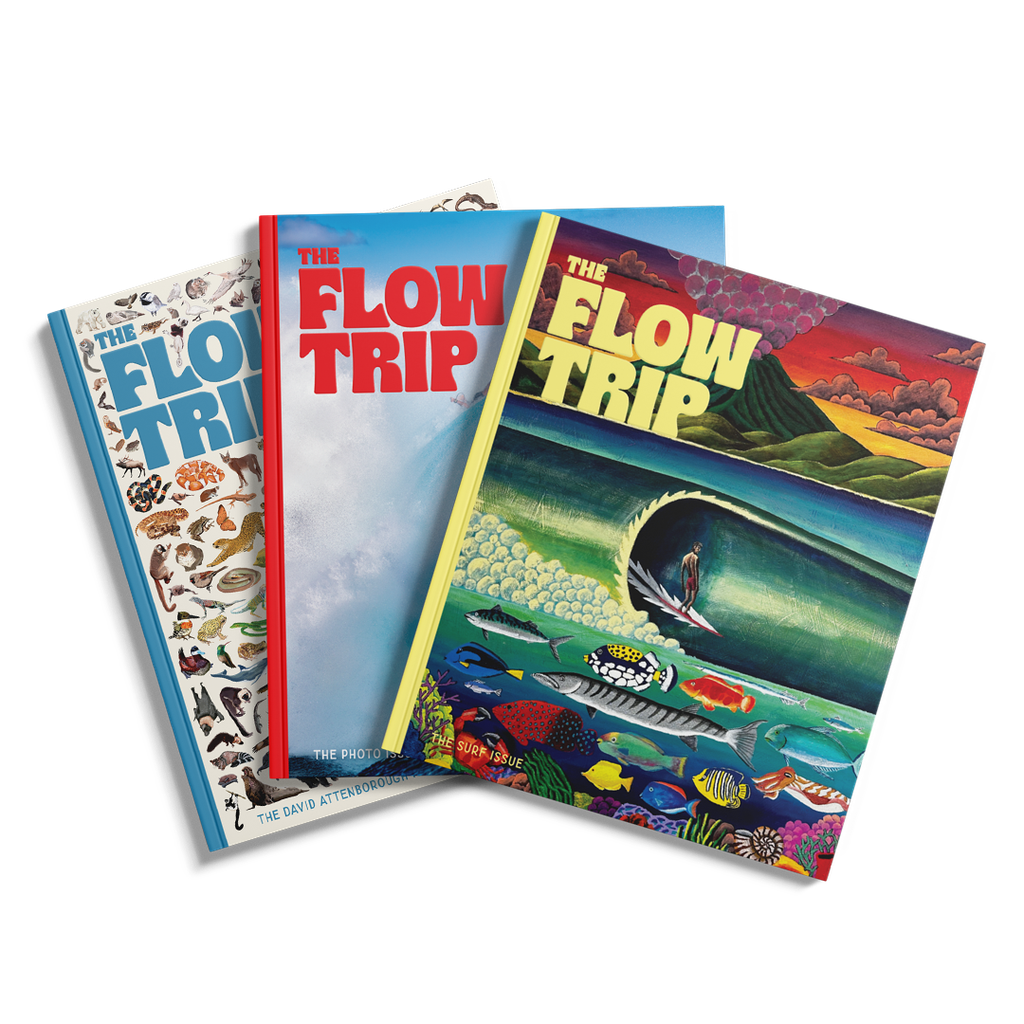
Subscribe to The Flow Trip
- Choosing a selection results in a full page refresh.
- Opens in a new window.