

The Flow of Florida
The Flow TripTapping into spirituality with local practitioners
Florida runs deeper than most people give it credit for. Both literally and figuratively. Sitting on what is considered one of the most unique geological formations in North America, the Florida Platform is an ancient limestone shelf that acts as the state’s physical foundation. One believed by many Indigenous tribes to be a resonance chamber, giving the land its own specific energy. Florida also has the densest concentration of freshwater springs on Earth — traditionally a place where the boundary between the physical and spiritual realms is thin. Built on the spiritual traditions from Indigenous, African, Cuban and European cultures, even today Florida is no stranger to cosmic energy. The Flow Trip crew was fortunate enough to sit down with a few practitioners rooted in Florida to see how they have tapped into the flow of Florida’s spiritual current.
Lori Bell | Acupuncture Physician, Astrologer

You’ve been called Miami’s “Good Witch” for years. What’s the origin story?
It started at Standard International's New York office. I’d been practicing at The Standard Spa in Miami Beach, and the CEO was introduced to me and asked, “What exactly do you do?” Without missing a beat, I said, “I'm the Good Witch.” And that was that.
At the time, it was a quick answer to a hard-to-explain job. These days it feels more like a title I’ve grown into. My hair tells the story of everything I’ve lived and learned, and I can finally wear the name fully.
How do astrology, Chinese medicine, and Tibetan Buddhism live inside each other?
For centuries, astrology and medicine were one discipline — there’s a line often attributed to Hippocrates that says, “A physician without a knowledge of astrology has no right to call himself a physician.” Studying traditional and medical astrology made integrating it into my acupuncture practice feel like a natural progression, and now I read people through both lenses at once.
Tibetan Buddhism is what holds it all together. Daily meditation has made me kinder and less judgmental, and the more those qualities grow in me, the more easily I see the good in others.
They aren’t three separate things. The chart shows me the pattern, the medicine lets me work with it in the body, and the practice lets me meet it with compassion. Any one alone is useful. Together, they see the whole person.
You describe astrology as the cosmic weather report, never there to dictate, only to enhance. What's the difference between someone who uses it as a crutch and someone who uses it as a compass?
A crutch is when people lean on astrology so heavily that they stop living in the present. They’re waiting on a transit instead of showing up for their life.
A compass helps you orient. The chart is the cosmic weather report: It tells you whether to bring an umbrella, not whether to leave the house. If you get a great job offer while Mercury is retrograde, take the job! Just read the contract twice.

What has this work asked you to surrender, and what has it given you back?
It asked me to surrender control of the outcome. I can bring everything I have to a session, but I don't get to decide what happens afterward. Learning to let that go has been its own practice.
What it's given back is presence. My patients and clients have taught me to learn, to observe, and to feel it all. But feeling it all doesn't mean taking it all seriously. Seeing the impermanence of everything unlocks new portals of perception, and it lets you play more freely.
Florida is not a place most people associate with deep spiritual life. What does this state hold that people aren't seeing?
Miami has a real spiritual community. You just have to go looking for it. Be discerning, and don't follow anyone blindly.
I found what I was looking for here. I met my astrology teacher, Brenda Brush, when I was in my twenties. In 2004 I was involved with the teachings the Dalai Lama gave at the University of Miami. And in 2010 I met my root teacher, here in Miami.
Know what you're in search of, then go find it.
What's one thing someone could do tomorrow — no experience, no tools, no background — that would crack the door open to the way you see the world?
Ask yourself one question: What makes me feel expansive and present? Then go do it.
Spend your time on what actually brings meaning to your life. When we feel aligned and expansive, we become more open, less judgmental, and kinder.
Bob Linde | Acupuncture Physician, Registered Herbalist with the American Herbalists Guild

Plants have been healers long before humans knew what to call them. You’ve been a lobster diver, Desert Storm infantry soldier, and a Greenpeace worker; how did you get into holistic living and how has using plants changed your outlook on life?
I have been a science nerd since I was very young. I first wanted to be a herpetologist, then by the time I was 10 it was assumed I would be a medical doctor (mom was a medical writer). I first started learning about edible plants at about the age of 10 and quickly became aware of the medicinal use [of plants]. I got a full academic scholarship and became a pre-med student, and hated it, so I explored other opportunities, including the Army. Just like that, I was deployed to Desert Storm with the 3rd Armored Division. On returning to Germany from the desert, I began to exhibit symptoms of Desert Storm Syndrome. Doctors said nothing was wrong, and my knowledge of herbs and supplements didn’t seem to work. I went to the local acupuncture school to get help, and they explained there was a diagnostic system outside the medical diagnostic system. The energetic system of Chinese medicine opened my eyes to a new way to understand health, plants, food, and the world as a whole.
Without a doubt my relationship with plants has changed my worldview. I believe that plants are our teachers, we just need to be able to take the time to listen. I spent a week sitting with a single plant in Scotland, two hours, every day for a week. At the end of the week, I learned a new use of raspberry stem that had never been seen before.
You grow over 150 medicinal plants in your own yard. What's the one plant in that yard that still surprises you — something that keeps revealing new layers no matter how long you've worked with it?
I likely would change that answer every week. But honestly, I think it might be a tie between Bidens alba (Spanish needles) and Smilax spp (greenbriar and others). Bidens started as just food and something you can put on a bug bite. Now it can help a lingering cough after a cold and flu with clear or white phlegm (my own discovery), chronic Lyme, UTI, and so much more. With Smilax, it’s used in so many systems: Chinese medicine, Ayurvedic, Caribbean, Americas, and we can see its modern research for steroid-like compounds to help with inflammatory skin issues, various types of infection, and also a yummy snack.

Florida has such a specific ecosystem — the heat, the humidity, the springs, the scrub. How does the land here shape the medicine it offers?
Florida does have such a unique ecosystem that ranges from tropical north. Nature tends to adapt to the challenges that are presented to it. Even the invasive species can be used: Kudzu root is high in iron, helps with loose stools, is a tasty food, the flowers are used for stress, and the leaves are great to feed livestock. Spanish needles continue to fill areas that have been exposed to deforestation and development, providing food and medicine for the expanding tropical diseases that are moving north and having dramatic effects on our health. So many of our plants that grow in the swamps help with fungal infections. Common plants like lemongrass (known as fever grass) help us adapt to the heat and humidity.
Florida is not a place most people associate with deep spiritual life. What does this state hold that people aren't seeing?
I would say there is a huge number of spiritual practices in the area. Much of it is in the Black community through practices such as Ifá, and of course the practices of Caribbean and Central and South America’s Indigenous groups, who have brought some of their practices that have become popular and opened the door to more nature-based practices. And although many practice yoga and tai chi merely for health reasons, there are classes and practices in the more internal spiritual aspects of these movement meditations.
What's one thing someone could do tomorrow — no experience, no tools, no background — that would crack the door open to the way you see the world?
So many things! Belly breathing is one of my favorites — not box, not reverse, or any other of the advanced fancy methods. Just boring, basic diaphragmatic breathing. The other would be to walk in nature; value added if you take the time to sit with a plant and open yourself up to the messages that may flow to your mind.
Christian de la Huerta | Transformational Coach, Retreat Facilitator, Award-Winning Author, Speaker

You were on track for a PhD in psychology, your father was a psychiatrist, and then you found breathwork. What did the breath show you that years of academic psychology couldn't?
Psychology can help us understand our stories, our conditioning, our patterns, and the ways our past shapes us. That's invaluable. But there came a point when I realized I didn't want to simply understand myself better. I wanted to experience myself differently. And when I was studying, psychology neglected spirituality, an important aspect of being human.
Breathwork gave me access to something beneath the level of the mind. I could have an insight intellectually and say, "Yes, I understand that." But there is a very different kind of knowing that happens when something moves through the body.The breath showed me that transformation doesn't always begin with understanding. Sometimes it begins with experience. And that became a part of my work: How do we move beyond just knowing about ourselves to actually knowing ourselves?
The breath is the one thing every human does from the first second of life to the last — and most of us have never consciously worked with it. What happens when someone breathes with intention for the first time?
There's often surprise, even amazement. People discover that something they've been doing automatically and unconsciously their entire lives can actually be life-changing. They may notice sensations, emotions, memories, insights, and a level of aliveness and connectedness they haven't experienced before.
But I don't think there's one universal experience. That's part of what makes the breath so fascinating. For most people, it's calming and relaxing. For others, it can be energizing or emotionally moving. Sometimes what emerges is physical rather than emotional. And sometimes the most powerful experience is simply realizing, perhaps for the first time, how much we've been living from the neck up. The breath brings us back into direct experience. Most of us live in our minds. Breathwork guides us into the body and beyond, into transpersonal experiences. And that can open a very different relationship with ourselves.
How do you reconcile the science of psychology and the practice of breathwork? What does each one understand about healing that the other misses?
I don't see them as opposites. I see them as different ways of approaching the human experience. Psychology gives us language, context, frameworks, and an understanding of how our history and conditioning influence us. That's incredibly valuable, yet it can limit us to a surface aspect of the human experience. Breathwork brings us into the body and into deeper experience. It can give us access to dimensions of ourselves that aren't necessarily available through thinking.
Where I think we sometimes get into trouble is believing that because we understand something intellectually, we've transformed it. As I have witnessed countless times, we can know exactly why we do something [that we shouldn’t] and yet continue doing it. We can understand our childhood patterns and still be governed by them. We can have tremendous insight, and very little freedom. For me, the most interesting work happens when understanding and experience meet — when we can bring consciousness to both the story and the body carrying the story.
You've built 30 years of work on the idea that breath is actually one of the most powerful healing tools a human has. Make the case.
First, I would say that breathwork isn't a magic cure-all. And yet, over more than thirty years, I have witnessed countless instances of healing — at multiple levels, including physically — that defy explanation and leave me genuinely humbled. I don't use the word "healing" to suggest that breathwork replaces medical or psychological care. Rather, I have seen it become a powerful complement to both.
What makes the breath extraordinary is its accessibility, its simplicity, and its position at the nexus between the conscious and unconscious. We breathe automatically, but we can also consciously change the way we breathe. That makes the breath a kind of bridge between what we consciously control and what is happening beneath conscious awareness. Sometimes deep emotional trauma clears. Sometimes there is a physical release. Almost always people attain a place of profound stillness and inner peace. Sometimes there is simply a sense of coming home to oneself.

Florida is not a place most people associate with deep spiritual life. What does this state hold that people aren't seeing?
Florida is an interesting place because, at one level, much of what people see is surface and superficial, but beneath that, there's a substantial diversity of people exploring questions of consciousness, spirituality, healing, embodiment, and meaning. I remember thinking at first, Wow. What a spiritual desert. And then I started discovering an oasis here and there.
Since then, I've encountered extraordinary human beings: seekers, practitioners, teachers, artists, entrepreneurs, and people simply asking deeper questions about their lives. Maybe spirituality doesn't always look the way we expect it to. It doesn't have to happen in a monastery or on a mountaintop. Sometimes it's happening in the middle of a city, in someone's living room, in a yoga studio, on a beach, or in the quiet moment when someone finally stops long enough to ask: “Is this really the life I want to be living?” Maybe spiritual life isn't always about finding the perfect environment. Maybe it's about learning to see what's already there — even in places where we least expect to find it.
What's one thing someone could do tomorrow — no experience, no tools, no background — that would crack the door open to the way you see the world?
Stop. Even just a couple of minutes, put everything down. No phone. No music. No meditation app. No goal. Simply pause, and notice your breath.
Then ask yourself three questions: What am I feeling? What am I sensing in my body? What have I been too busy to notice?
Don't try to change anything. Don't try to have an insight. Don't try to become more "spiritual." Just notice. Sometimes the doorway is simply pausing, and becoming willing to be where we are.
Then we might discover that beneath all the noise, there's something inside us that's been trying to get our attention for a very long time.
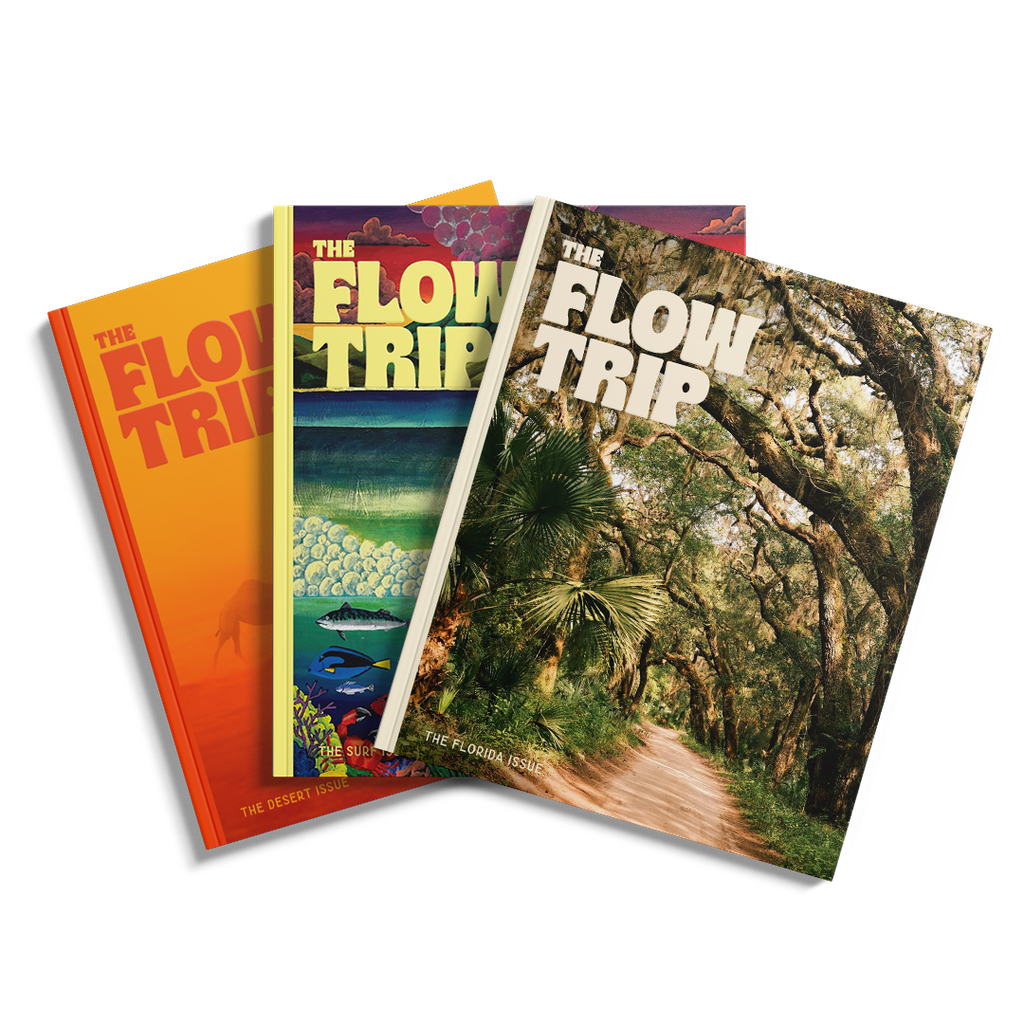
Subscribe to The Flow Trip
- Choosing a selection results in a full page refresh.
- Opens in a new window.