

More than Surf
The Flow TripBeyond the waves with surfers we admire
Words and photos by Morgan Maassen
One of the most breathtaking facets of surfing, is that no single two people will ever have the same understanding or appreciation of our sport. And with so many different ways to approach it, surfing so righteously attracts the most exquisite of characters. I've ridden waves amongst people crazed about competitive prowess, I've enjoyed serene sessions looking for a meditative getaway, and watched people deliver art expressing unprecedented creativity. Surfing allows us a way to see the world and embrace nature, as well as find growth and release in ourselves.
I caught up with a few people who are thriving in surfing, because of surfing, beyond surfing — these people are the tup of the iceberg of representing the vast beauty of our sport, but brilliantly illustrate how surfing can propel one through life. And while surfing starts as a singular pursuit, it is anything but. We're a tribe of doers, makers, explorers, and people seeking growth in the hands of nature.
Nole Cossart
Nole Cossart uses surfing to keep his creativity sharpened as he navigates life, family, and his endless fringe passions.

As a young aspirational pro surfer, did you consciously think to entertain all your quirky passions and interests, or did they come later in life?
I think I started to develop that trait early on. I grew up in a rural area about an hour from town and I remember spending a lot of time bored and having to come up with ways of entertaining myself. Our family didn’t have money for new things, so if I wanted something I often had to scrap it together myself.
I remember tearing toys apart and rebuilding them with hot glue into Frankenstein things like the villain in Toy Story. I think that curiosity and scrappiness came in handy when I was trying to pursue professional surfing. I wasn’t a good enough high-performance surfer to make it as a pro, so I naturally started to gravitate to the fringe ideas.
What was it like switching into a new gear and seeing pro surfing in the rearview mirror?
It was actually super relieving. It was a great release to abandon this expectation I’d put on myself of what level I had to perform at to become a professional surfer. Since I lacked the prodigy talent to be a real pro, it meant that I felt like I was never good enough — always judging my sessions, comparing myself to the best surfers, and getting down on myself. I think that feeling drove me away from performance surfing. When I realized the pro surfing dream was behind me, I wanted to strip away the angsty baggage and rediscover the spark of joy in simply riding waves.
What did surfing set you up for in later life?
It’s definitely shaped my entire life and the directions it’s taken. Because of surfing I refused to get a real job when I was young because I was afraid I’d miss surfing opportunities. Later on that same sentiment drove me to want to start my own business, so that I could be the master of my own schedule.
I think there’s a lot of shared values and philosophies between someone who creates their own career and surfers. The sense of being inspired to follow an idea, or a swell, or an opportunity. We learn to be flexible because our opportunities are dictated by so many conditions outside of our control — the wind, swell, tide — so we do our best to prepare ourselves and arrange our lives to take advantage of those opportunities when they arise. And once they do, we’re ruthlessly obsessive about getting after it. We get up before dawn to chase something that we want, something that compels us. We aren’t being pushed by society or conformity to get after it, we’re being pulled to it. Surfing has guided me to live a life that’s inspired, not contrived.

How does the ocean and surfing help you function in your present life?
It’s extremely calming. Even when I’m locked in working on my business, just pulling off the 101 freeway for 15 minutes on my commute to put my feet in the water is such a grounding reset. When you’ve made a lifetime of memories and core experiences in the ocean, just dipping in the water briefly can bring you back to them. Maybe that’s why old surfers don’t seem to need to catch as many waves to access that satisfaction from surfing. Just being there briefly brings it all back.
Ryan Lovelace
Ryan Lovelace's relationship with surfing starts with craftsmanship and has no end in sight, as he ascends in his understanding of the craft we dance on.

What initially drew you to shaping surfboards?
I'd like to say need but it was really just a deep, deep want. I really wanted to try different boards, and I was raised to build things, so once the door was opened in my mind and I realized I could just make my own instead, it was on. I don't naturally have that thing in my mind that says “you can't” or “you shouldn't.” If I can see a way to do the thing I want to do I'm definitely going full bore into it with minimal questions about the outcome or reasoning.
What has been the most inspiring part of your career and craft?
Friends. I feel super fortunate for the relationships I've built through this — my work is my life, so it's all hyper-interwoven, the relationships that have sprouted from blindly following my own path.

What is the most peculiar or interesting part of shaping surfboards?
Disappearing. There are moments all the time when I'm shaping where everything just vanishes, it's so freeing. It's a full flowstate thing for me, not in the “I've reached a higher plane” kind of thing, but more like when you're driving on a perfect day and everything's good and the perfect song comes on and nothing else exists. Like that, but with power tools. It's super fun, and it happens pretty much every time I shape a board.
How have you continuously evolved, and what is next?
I think by just surrendering the expectation of evolution. Trusting that it'll come and taking off the pressure seems to be the thing that brings it for me. Board design seems to be on a three- to five-year cycle for me, so I trust in that fully and just follow what I'm feeling when it comes to new designs or ideas. I know that if I force something new in business or relationships, it's never the thing that's really right for me.
So I tend to just keep my eyes and ears open to ideas, and the right ones are usually so right and so natural that they hit me like a freight train and all I have to do is get onboard and allow the change to happen. I have no idea what's next.

Vahine Fierro
Vahine Fierro, the pearl of French Polynesia, blends her undying connection to her roots on a tiny South Pacific island to the center stage of the World Tour.

What was life like growing up with perfect waves in the middle of the Pacific?
I grew up on an island called Huahine, 30 minutes by plane from the main island of Tahiti, 7,000 people, surrounded by the ocean. When my parents were done with their work, they would take me surfing with them. My dad has a shaping room and made all of our boards, since being on a remote island, it would be pretty hard to find a surf shop. At that time, I didn't know how spoiled I was to surf world class waves with just my parents and my sisters out there, riding our dad’s boards.
How did dreams of the World Tour and Olympics come into play?
My dad pointed out to me that he thought I was good enough to try to compete. So I flew out to the main island by myself, competed in my first local contest, got third in the final, came home crying because I lost, then I told my parents I wanted to start competing. I knew that if I wanted to get better at surfing, I needed to get out of Huahine, into the “real world,” and start surfing beach breaks and go left. I learned how to go left at the age of 13; I had never gone left prior to that since I wasn't competing. So technically, the World Tour and Olympics at that time were not even in play, I was just a little girl, finding a purpose day by day, and ultimately that's where it led.
What do you think and feel when you're paddling into a monster at Teahupo’o?
When I set a toe in the water out there, I am already scared. Big or small. And when it's my turn to go for the wave I want, I usually try to commit at 200 percent. If not I don't even paddle for the wave, because this wave doesn't give you room for hesitation. Hesitation and Teahupo’o don't belong in the same room.
So I paddle as hard as I can, I see the ocean drawing up the face so I have to start kicking my legs to go even faster, then I stand up, and once I make the drop, all five senses are turned on. My vision is so clear: I see the mountains, the boats, the photographers in the lineup, the ocean surrounding me in a circle shape, I hear the sound of the ocean, it feels like I am in the heart of the whole Pacific. It’s where I have no more thoughts, it’s where I reconnect with something greater than this world. It may sound exaggerated but it’s truly that feeling. The feeling of being alive. And when I come out of the barrel, every time I have the biggest smile.
What is it like being a part of such radical progression in women's surfing?
To be honest, I don't know how I got myself in this position. My first time surfing Teahupo’o was at the age of 15, during a local contest in Tahiti. I didn't catch a wave, lost the heat, and never came back until I was 17. At that time, I was still watching from the channel more than surfing it, but I could see Kauli Vaast, Matahi Drollet, and all the Tahitian chargers always so happy after surfing Teahupo’o. I wanted to feel what it was like to be happy out there. It wasn't about wanting to be a charger or win the championship title, it was more about chasing a feeling that made me feel alive, and that's where it led me to.
Freddie Meadows
Freddie Meadows, a surfer from a place known to have no surf, experiences nature and evolves himself through his pursuit of elusive rides in the frozen world.

What is it like being a Scandinavian surfer?
The essence of what we do — riding waves — is more or less the same as being a surfer anywhere in the world. It’s what happens surrounding the actual surfing that seems so far removed. The nuances and details, seeing a blizzard outside whilst having your morning coffee at 9 a.m. while it’s still dark, knowing you’re about to pack the car and head to surf. Or planning a 10-hour drive for a four-hour swell window at a wave that may break once every few years. There are definitely times where your motivation to surf is tested, the parallel being that it’s always an adventure, exciting, unique, and potentially quite extreme.
What are the highest highs and lowest lows of your pursuit of waves?
There are just endless amounts of empty coastline, so the highs are so rewarding. Timing that miraculous session at waves you’ve spent years envisioning and studying on maps is such a beautiful experience and sense of accomplishment. Not in a show-off way, more just a way of feeling deeply connected to what you love and believe in.
The lows are the mirror of all the above. You can also feel the disconnection in a strong way — you surf less and it’s not as easy. Long flat spells, or any of the multiple factors that keep you out of the water up here; it can all lead to one losing that connection, that sense of being a surfer that I personally feel is so important and fulfilling, as it’s the reason for being there and doing any of it in the first place.

Do you get scared in the remote settings you find yourself in? Do you embrace the solitude?
At times I get scared of what could go wrong, the remoteness, and the entirety of it all. Especially in waves of consequence. With that being said, I think I’m more scared of not doing what I love and what I believe in.
And in regards to solitude, I feel there’s a time and a place in anyone’s life to embrace that, if that’s what you’re driven to do. I’ve had such a drive to immerse myself, whether that's with company or not. One thing with solitude is that it’s not sustainable, it always leads you back to the realization of life being better shared, which is wonderful.
What does surfing in Scandinavia give you that no other place could?
Purpose.

Mikey February
Mikey February translated a life of competition into the stepping stone he needed to explore the world with his family, blending art and music to the delight of everyone following his journey.

How have you carved out your niche in surfing? Was it something you pushed for, or did it happen organically across your interests, films, music, etc.?
In the beginning stages, it was learning how to surf and doing it with friends. For influences, naturally you look up to people doing it the best and competing, but being in South Africa, the only way to be supported as a surfer was competing. I naturally fell into it, and wanted to do it to the best of my ability, through the World Surf League Qualifying Series, with the goal of making the Championship Tour. Naturally through the QS, you don’t get to express yourself much, and I really admired people who did that through films, combining surfing and music.
Eventually, after seven to eight years trying to qualify, I reached my goal of being on the tour, which unlocked more support and opportunities, and that actually opened the door to exploring the creative side of things more. That first year on the tour, I did my first freesurf project, in Ghana, to film Nü Rythmo. It connected so many dots for me, and allowed me to think. Combining support from my sponsors and being able to collaborate with creative people is when it all made sense. Working on something creative, like that film, was really what I wanted to do, and that trip was it.
What is your favorite part about melding your interest in the arts with surfing?
As I grow older, I do find a lot of influence in surfing, but I find more outside of surfing: in music, art, people. I think it's really exciting to play around with the challenge of blending music and surfing. Everyone understands both, so it's this bridge to help other people outside surfing understand, because not everyone gets to experience it.
Was the world tour what you wanted it to be? How is life after?
I’ve been competing since I was 10 years old, so making the tour wasna huge accomplishment. I worked for it for so many years, so it was amazing to achieve such a long-term goal. I think after so many years of being a professional surfer and focusing on it, that I found that riding one type of surfboard — performance shortboards — and constantly refining it, turned out to be such a single-minded focus. It was like staring at a little dot for too long, and it became blurry. After all that dedication and reaching that goal, I think I definitely burnt out. The need and hunger to be that type of surfer disappeared, and a new hunger to dive into surfing to explore it more creatively and broadly was what I was drawn to.
Carissa Moore
Carissa Moore, the first Olympic Gold Medalist in surfing, is now carving a path for more women and girls to get into the water.

Photo by Red Bull Content Pool
Explain how it felt to be the first Olympic Gold Medalist in surfing, and what that means for the future of women in surf.
It is an honor to be the first Olympic Gold Medalist in surfing. It is huge to have surfing on the Olympic stage and feel like it will continue to bring more eyes and inspire more girls to get out there and try.
Explain the mission behind Moore Aloha and what drove you to start it.
I started Moore Aloha in 2018 because I wanted to create safe spaces for girls and women to come together to engage, share, and support each other. I think it’s easy to look around and compare and not feel “enough,” but when we actually have those honest, real, vulnerable conversations, we realize we aren’t alone. Moore Aloha focuses on using culture, community, movement and mentorship to help cultivate mental health and wellness. Being a steward of the land and sea, taking care of the world around us, connects us to something bigger than ourselves.
What’s next for Moore Aloha?
We are hosting a weeklong workshop in Waimānalo for girls that focuses on building self-worth from the inside out. We are partnering with World Surf League and their Rising Tides program, working on surfing with purpose and sharing tools to create a healthy competitive mindset.

Photo by Red Bull Content Pool
What is the most rewarding thing you have seen from Moore Aloha in regards to helping girls and women for mental health, culture, and surfing?
I think the most rewarding thing that’s come from Moore Aloha is seeing the friendships and connections made or hearing that the event was something someone needed to remember their worth and find their joy again. That’s what it’s all about.
Pen to Paper
FlowMorgane's Story
Flow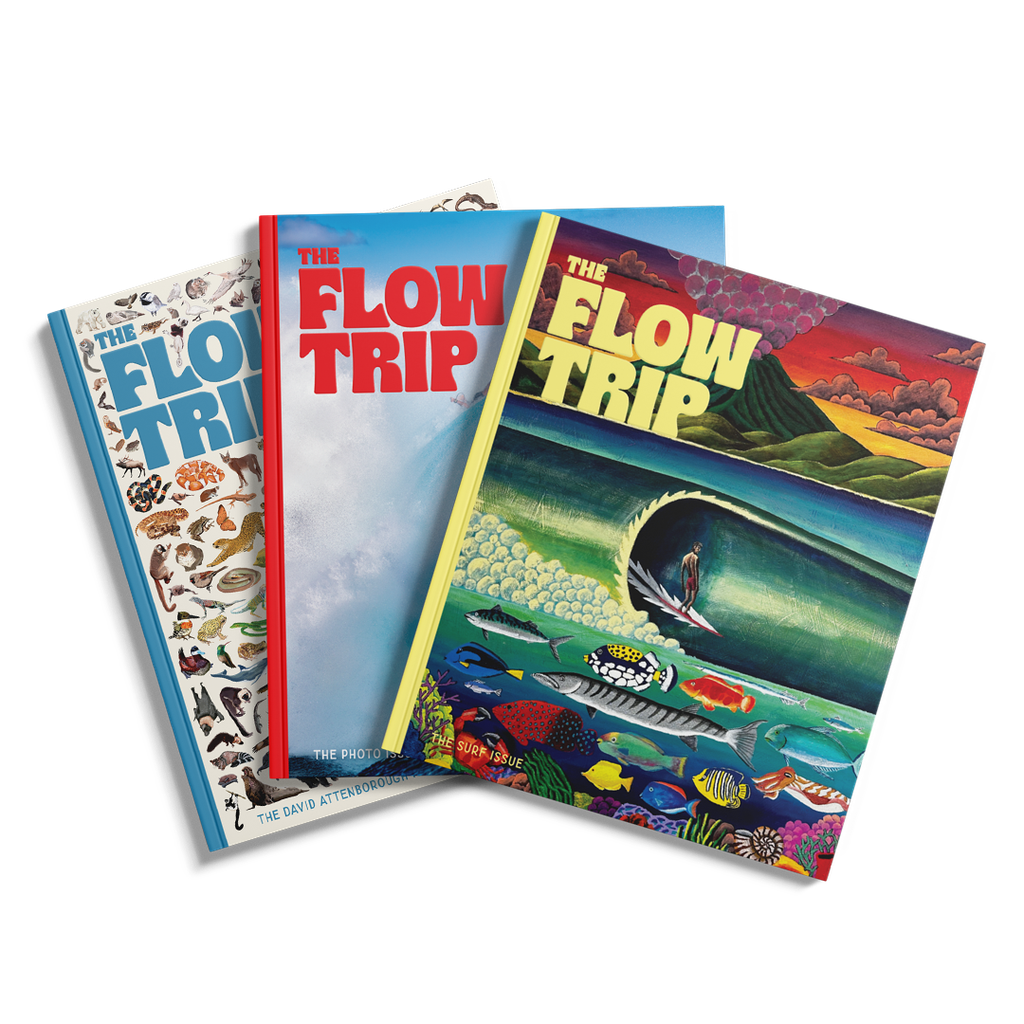
Subscribe to The Flow Trip
- Choosing a selection results in a full page refresh.
- Opens in a new window.